Connecting the Scholastic Corpus
Jeffrey C. Witt (Loyola University Maryland)
https://jeffreycwitt.com | jcwitt@loyola.edu
August 12, 2026, St. Louis University, St. Louis, MO
Slide Deck: http://jeffreycwitt.com/slides/2026-08-12-stlouis
Drawbacks to the Print Publication Paradigm
1. Progress is slow
2. Work is isolated and fragmented
3. Access is tightly controlled
Re-thinking what it means to make an edition "Public"
1. Textual data should be rigorously separated from data presentation
2. Textual data should be continuously revisable
3. Textual data should be freed from the artificial confines of the "codex" or the "website"
Paragraph (Document) Feature Vector
as
a Vector recording ngram presence (1) or absence (0)
Paragraph | 4gram1 | 4gram2 | 4gram3 | 4gram4 | 4gram5 | 4gram6 | 4gram7 | 4gram8 | 4gram9 | 4gram10 | 4gram11 | 4gram12 |
Doc A | 1 | 1 | 0 | 1 | 0 | 1 | 1 | 1 | 0 | 0 | 1 | 1 |
as
Dot Product of Document Feature Vectors $$ A \cdot B = \sum\limits_{i=1}^{n}{A_i B_i} $$ If Dot Product of A and B >= 6, then Doc Vectors A and B are "similar"
Paragraph | 4gram1 | 4gram2 | 4gram3 | 4gram4 | 4gram5 | 4gram6 | 4gram7 | 4gram8 | 4gram9 | 4gram10 | 4gram11 | 4gram12 |
sum |
Doc A | 1 | 1 | 0 | 1 | 0 | 1 | 1 | 1 | 0 | 0 | 1 | 1 |
8 |
Doc B | 1 | 1 | 1 | 0 | 1 | 1 | 1 | 1 | 0 | 1 | 1 | 1 |
10 |
A * B (Dot Product Vector) | 1x1=1 | 1x1=1 | 0x1=0 | 1x0=0 | 0x1=0 | 1x1=1 | 0x0=0 | 1x1=1 | 0x0=0 | 0x1=0 | 1x1=1 | 1x1=1 |
6 |
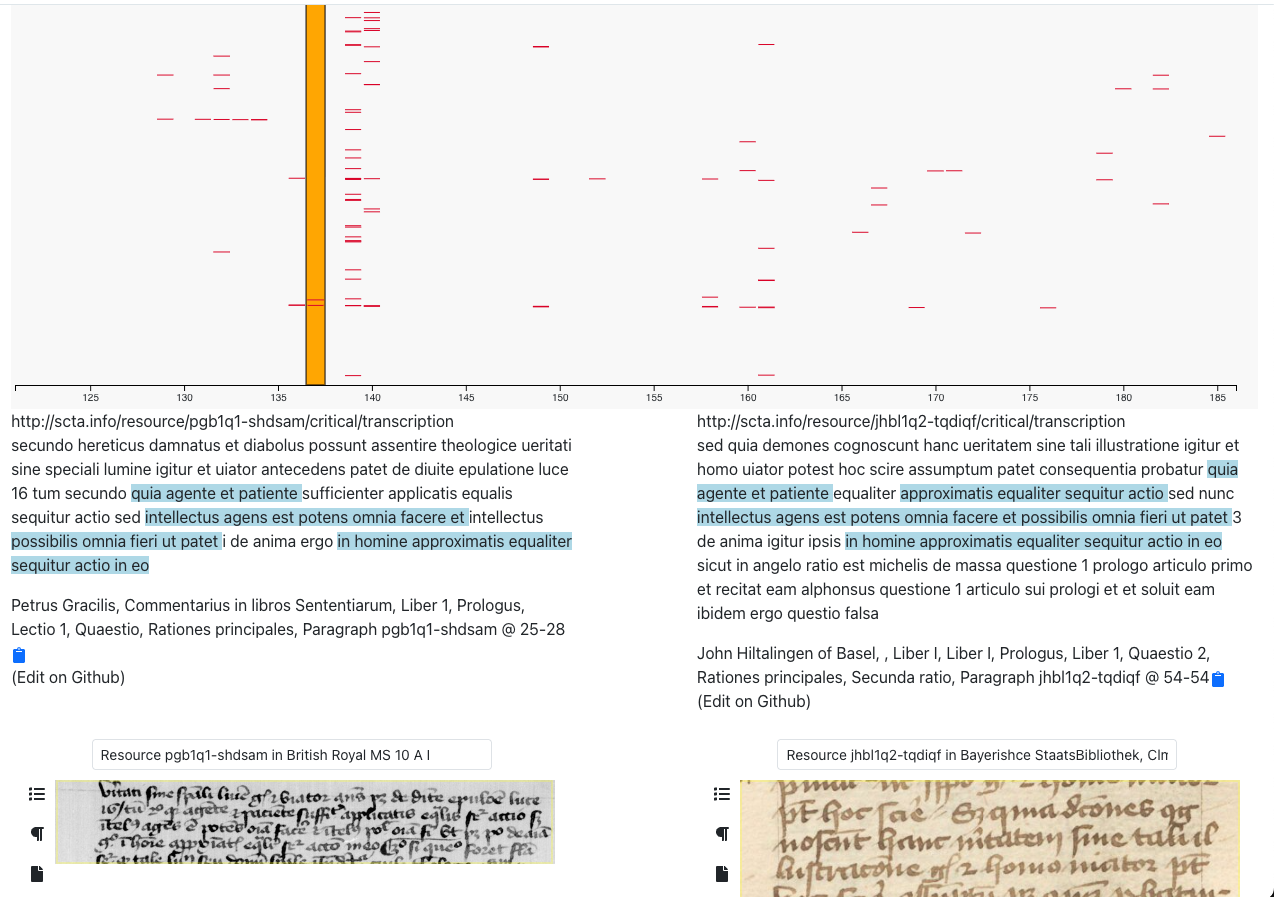
| ||5|6|7|8|9|10|11|12| |---|---|---|---|---|---|---|---|---|---| |2|0|0|0|0|0|0|0|0| |3|0|0|**0**|**0**|**0**|**0**|0|0| |4|0|0|**0**|**1**|**0**|**0**|0|0| |5|0|0|**0**|**0**|**1**|**0**|0|0| |6|0|0|**0**|**0**|**0**|**1**|0|0| |7|0|0|0|0|0|0|0|0| |8|0|0|0|0|0|0|0|0| |9|0|0|0|0|0|0|0|0| |
| ||5|6|7|8|9|10|11|12| |---|---|---|---|---|---|---|---|---|---| |2|0|0|0|0|0|0|0|0| |3|0|0|**0**|**0**|**0**|**0**|0|0| |4|0|0|**0**|**1**|**0**|**0**|0|0| |5|0|0|**0**|**0**|**1**|**0**|0|0| |6|0|0|**0**|**0**|**0**|**1**|0|0| |7|0|0|0|0|0|0|0|0| |8|0|0|0|0|0|0|0|0| |9|0|0|0|0|0|0|0|0| | X |
||||| |---|---|---| |1|0|0|0| |0|1|0|0| |0|0|1|0| |0|0|0|1| | = |
||||| |---|---|---|---| |0|0|0|0| |0|1|0|0| |0|0|1|0| |0|0|0|1| | = |
3 |
Conclusion
1: Machine Learning and AI tools can be positively used in our field when our texts are prepared as data first.
2: The traditional publication paradigm is in conflict with the data-first paradigm required for corpus-wide machine analysis.
C: If we want to reap the benefits of machine analysis, there is an urgent need for scholarly editors and academic institutions to support and demand a new publication workflow.