A Milestone in the Progressive Publication of Adam Wodeham's Ordinatio
One aspect of the data-first publishing approach of the Scholastic Commentaries and Texts Archive that I frequently emphasize is that, once data has been starkly divorced from presentation, data is free to be published “early and often”. This tagline from the open source community comes with the equally famous corollary that “with enough eyes all bugs are shallow”. This means that the earlier we release the data, the more people can not only start reading and using the data, but also provide edits to help us improve the data.
This is only possible with a progressive publication approach. When data is tethered to its presentation, it becomes fixed and static. Here it might be possible to detect bugs, but they can’t be emended, and thus they remain as deep as ever.
When divorced from presentation and published strictly as version controlled data, the same data can be both published and republished, progressively growing and improving.
While there are many advantages to progressive publication, it does challenge the conventional notion that when something is “published”, it is done, complete, and fixed.
The notion of being “done” no longer makes sense in a world where data can be constantly emended.
And this creates a serious problem: if contributors can only get credit for their work when a project is “done”, then – in a vicious cycle – few people will be willing to contribute to an editorial process that has no end.
To remedy this, we need a new concept of publication that is distinct from the ideas of “fixed”, “complete”, or “done”.
Fortunately, there are other fields where publication has long been divorced from the notion of “completion” or “finality”. Software development is well acquainted with the notion of publication as a form of progressive improvement. And instead of the language of “finality”, they have adopted the notion of “milestones”.
Milestones offer us a way to mark progress, recognize hard work, and distribute credit to contributors for their work on an artifact that will be perpetually emended and improved by others.
In this spirit, I want to use this post to mark an important milestone: I have completed a “first pass” transcription of the entire Ordinatio by Adam Wodeham as it exists in the Paris, Bibl. de la Sorbonne, ms 193 manuscript.
More than 15 years ago, I sat down with a group of scholars interested in Wodeham’s Ordinatio. Our conversation centered on how we might complete a critical edition of this lengthy and challenging text. Our meeting consisted of some initial division of labor. We left with excitement that, as we went our separate ways, we would continue to work on our assigned texts and eventually produce a complete edition of Wodeham’s lengthy Ordinatio.
As often happens, life gets busy and other projects get in the way. Since our initial meeting, interest has waned and the project has all but been forgotten. To my knowledge, no one is still working on the Ordinatio text with the aim of producing a complete edition of the Ordinatio.
But over the years, I have continued (slowly, on and off, in between classes, on airplanes, and whenever I could find the time) to work on transcriptions of different parts of Wodeham’s Ordinatio. Over time, the cumulative effort of this work has paid off. This summer, I reached a milestone that deserves to be marked: I finished the “first pass” transcription of the entire Ordinatio, manually transcribing every word on every page as it exists in the Sorbonne, ms 193 manuscript.
The typed transcription consists of 637,676 words, which I estimate to be around 3,000 pages in a typical printed edition.
The entire text is now available in a readable form that can be searched and navigated in different viewers.
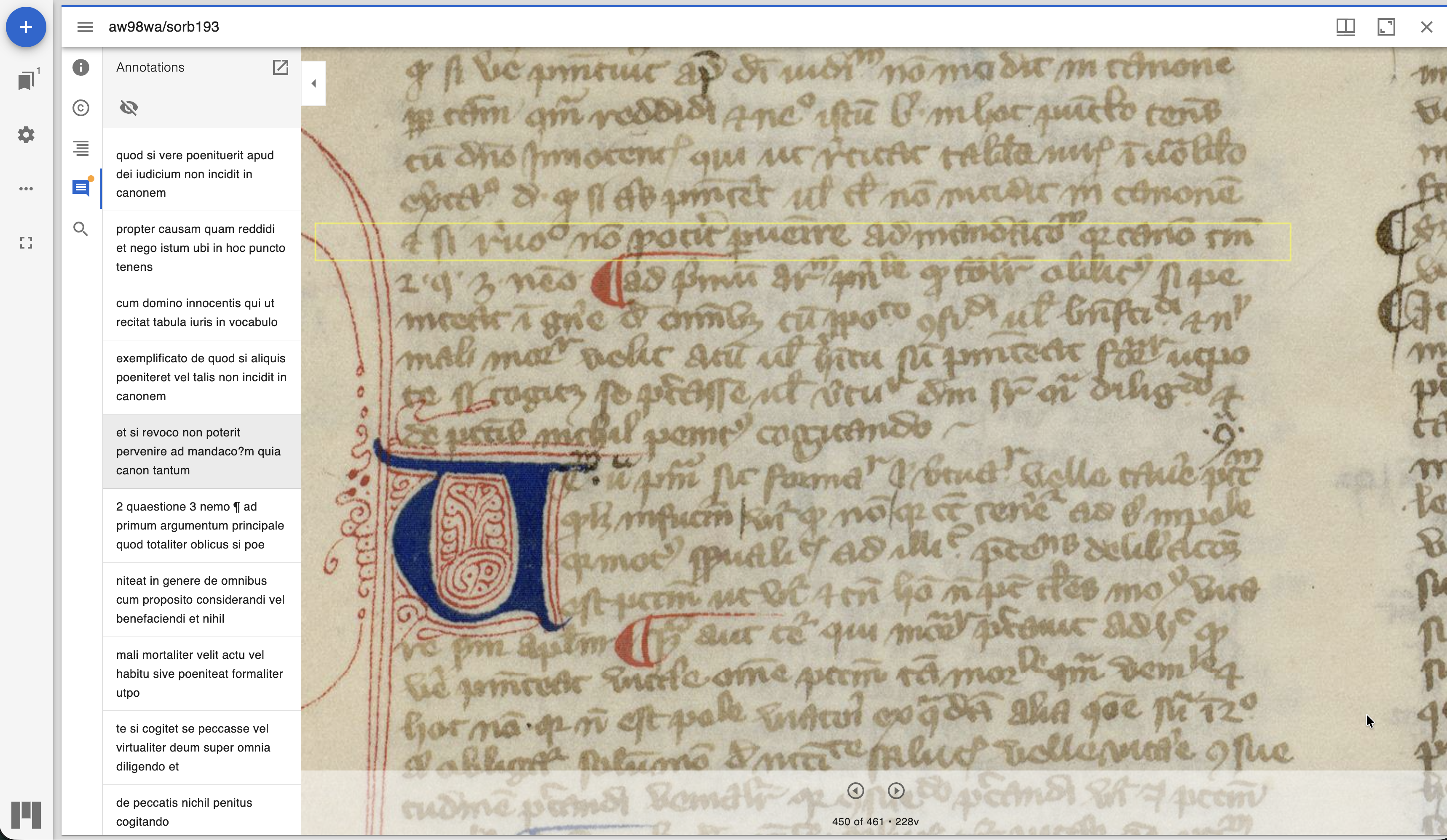
In the Mirador viewer, it can be read and searched as a line-by-line transcription of the Sorbonne, ms 193 manuscript.
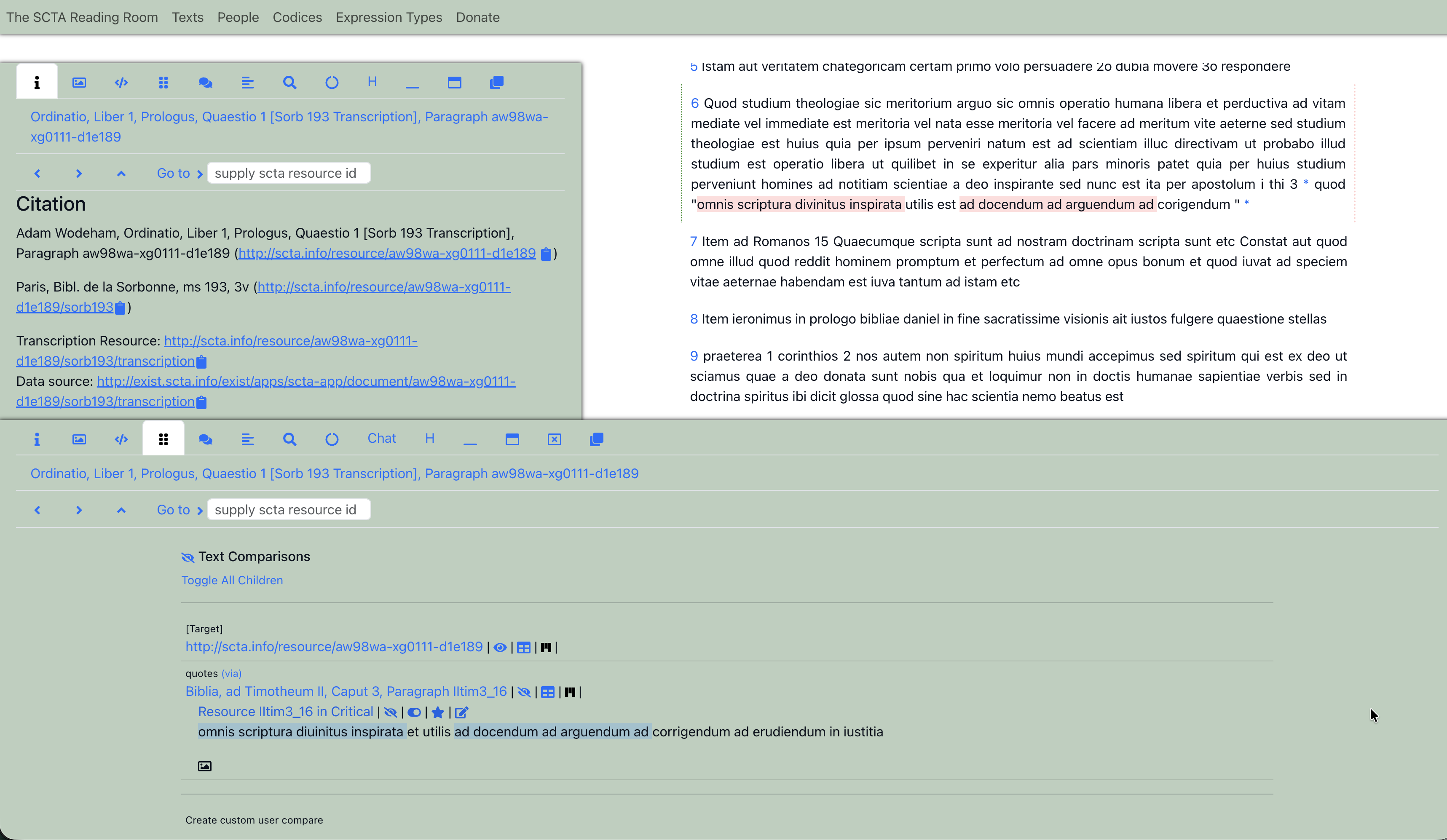
In the LombardPress Reading Room it can be read accompanied by a host of analytical tools.
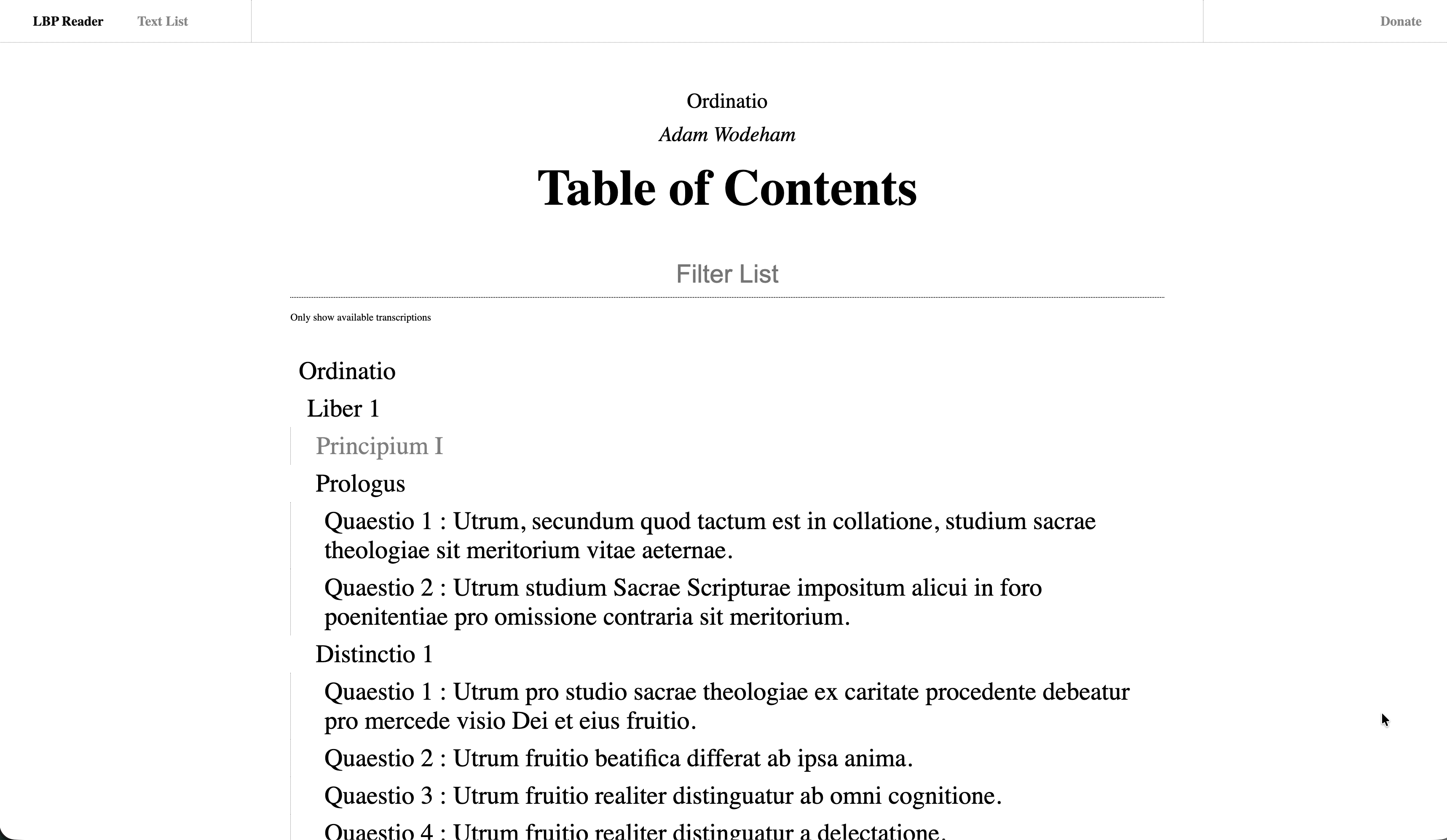
And in the Lombard Reader, it can be read in a viewer designed for simplicity, clarity, and distraction-free reading.
Reaching this milestone is in no way a declaration that the transcribed text is perfect. Far from it. Many difficult readings persist, either silently or marked with a ? or tagged as <unclear>.
But any perceived lack of quality in this “first pass” transcription should also be weighed against other positive quality metrics that are often overlooked: features that will enhance and accelerate our ability to improve the text.
Within the traditional paradigm, the word “quality” primarily refers to the accuracy of the transcription. But this perspective rarely takes into account other kinds of data and metadata that need to be preserved and collected in order to provide transparency into the editorial process (for example, through linking to underlying manuscript images) and to create deep network connections to other parts of the corpus.
Notably, because a printed edition cannot dynamically show the underlying manuscript images from every paragraph or line in the text, there is little incentive for editors to save and preserve the data points required to make this connection. To most people this oversight is not an indication of a lack of quality. But in a world where this kind of transparency is possible and should even be expected, an edition that fails to capture this data might be found wanting just as much as an edition with an erroneous transcription.
The current version of the Ordinatio edition, while it certainly still needs improvement in its transcription, excels in these other areas. I have painstakingly undertaken the labor of collecting the coordinates of every line in the digital images of the Sorbonne, ms 193 manuscript. Further, the transcription of this manuscript records every line break with the text itself. And it is the combination of these two data points (coordinate collection and line break recording) that makes it possible for a user of this edition to instantly call up the exact line of the Sorbonne ms 193 for any word of interest.
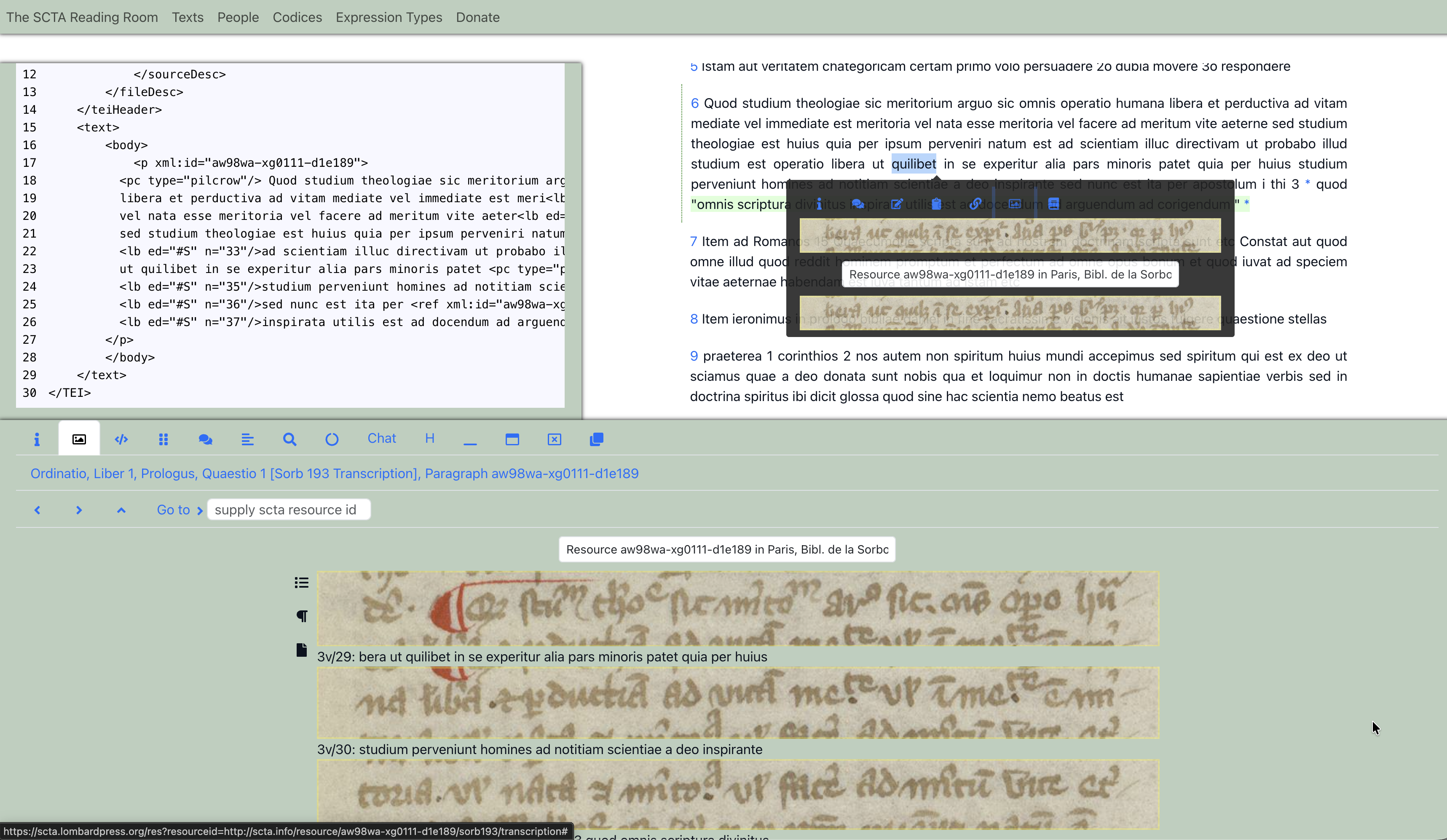
And here we can see why the idea of “publish early and often”, combined with these other features like text-image linking, represents a real qualitative advance over other editions. It both makes editorial decisions transparent, but this transparency also makes it easy for readers to propose changes so that the text can be improved over time. Here we should change the classic tagline of open source software from “with enough eyes all bugs are shallow” to “with enough eyes – and transparent data and an emendable system – all bugs are shallow.”
Finally, it is not just big fixes that add additional quality. The data-first approach to this edition, and its inclusion within the wider SCTA text network, means that connections can be made between it and other related texts.
Take, for example, the Abbreviatio of Wodeham’s Ordinatio prepared by Henry Totting of Oyta. This is a different text but a highly related one. We can not only prepare this edition in the same way, but also bring them together by preserving data links between the two editions.
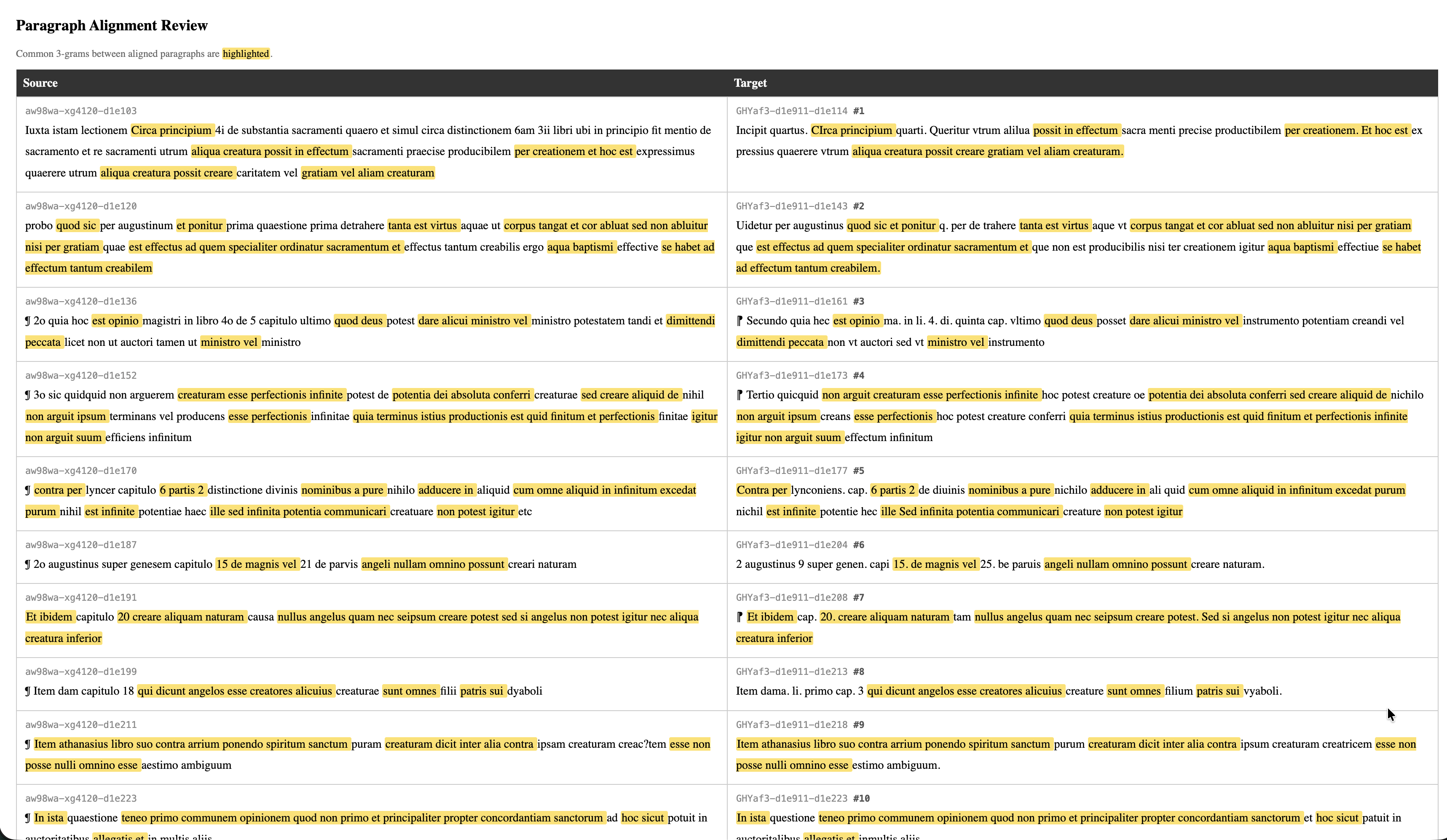
This is not something that a printed edition can do, and thus the preservation of these links is not usually considered part of what constitutes a quality edition. But now that we have this capability, one could easily turn the tables on a print edition with a perfect transcription. However great and error-free this transcription might be, we could say that – because it has lost many of these important data points – it fails in respect to these other quality metrics.
None of this is to say that I do not aim to continue improving the transcription quality of the existing Ordinatio text.
But the point is to say that with the completion of this “first pass” transcription of the Sorbonne manuscript, combined with these other quality metrics that traditional editions lack, we can accelerate the transcription of the other manuscript witnesses. And by retaining the data links between the Sorbonne transcription and other witnesses and editions, we can seamlessly compare parallel passages across all witnesses and improve all transcriptions based on these comparisons.
And we can do all this, while simultaneously giving scholars early access to the text in its current form. It is already in a high quality form that will allow scholars to begin studying and learning from the text. And as the text gets used, when a scholar finds a transcription error, they can simply click the “Propose Edit” button and actively contribute to the improvement of the text for the benefit of all.
If this is the first milestone in a system of constant improvement, what’s next? Well, this is exactly what we build in a “roadmap” of “milestones”.
Here you can see the live project board or roadmap describing and tracking the completion of milestones to which more milestones will inevitably be added.
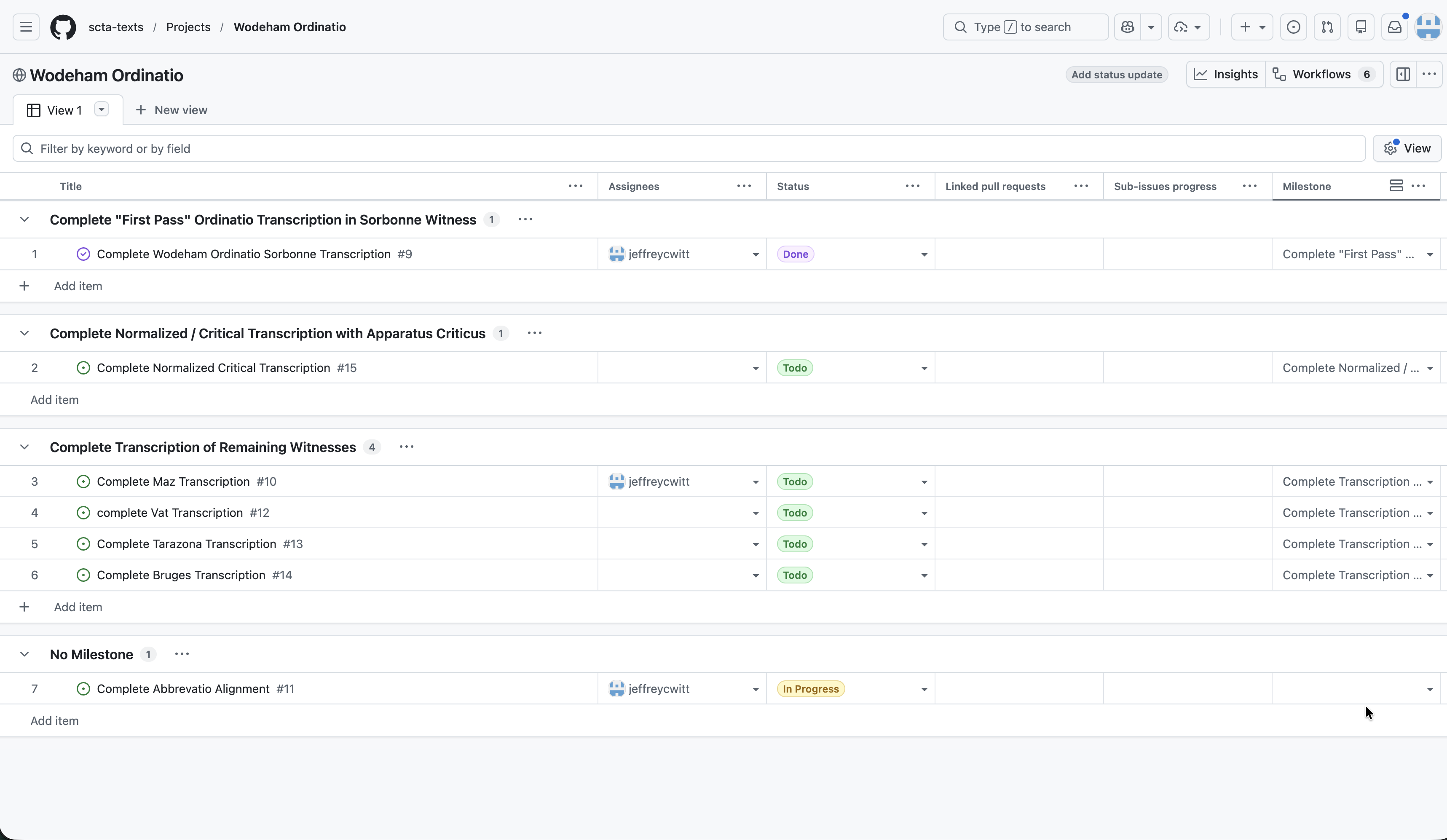
Thinking of “publication” as a roadmap of milestones is certainly a different way of thinking about how we make our texts public and track progress. But as the medium through which we make the historic record public changes, so too should our ideas of what publication means.